Salesforce's Planned Loops Acquisition: What It Could Mean for Tableau and AI Analytics
Artificial intelligence is changing how businesses analyze data, identify opportunities, and make decisions. Traditional analytics tools help organizations understand what has happened, but businesses increasingly want systems that can explain why performance has changed and recommend what to do next.
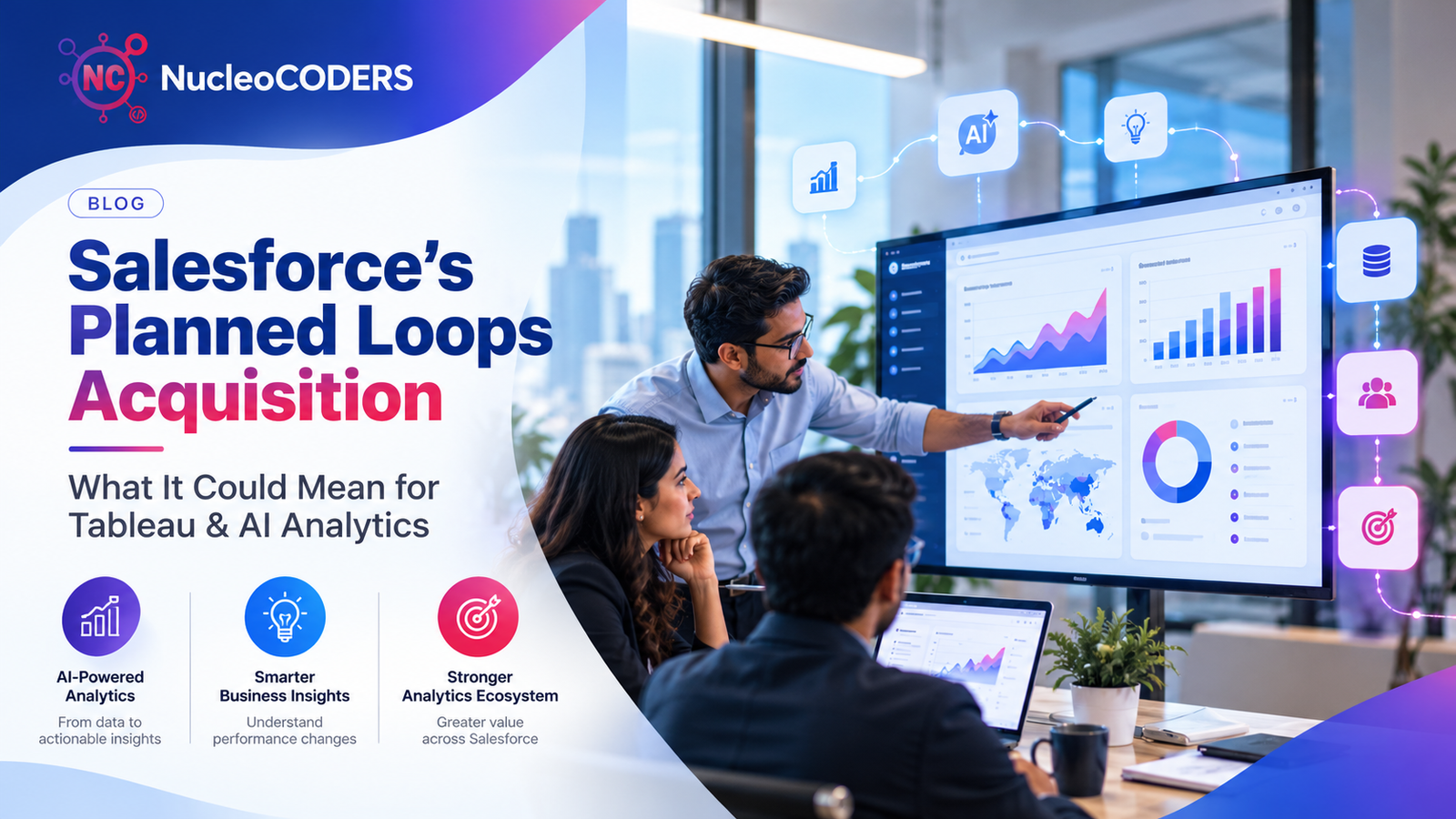
Salesforce is taking another step in this direction with its planned acquisition of Loops, an AI analytics platform expected to enhance Tableau's data analysis capabilities.
The development highlights a broader shift in enterprise technology: analytics is moving beyond dashboards and reports toward AI-assisted insights and more actionable business intelligence.
1. What Is Salesforce's Planned Acquisition of Loops?
According to a report published by Simply Wall St on October 13, 2026, Salesforce has agreed to acquire Loops and plans to integrate its technology into Tableau.
Loops is designed to help businesses explain changes in performance metrics and recommend potential actions. Its capabilities could complement Tableau's existing data visualization and analytics features.
The reported transaction was expected to close by early November 2026, subject to completion. The integration and its eventual business impact should therefore be assessed as the product develops rather than assumed to be fully available today.
2. Why Is Salesforce Interested in AI-Powered Analytics?
Businesses generate large amounts of information through sales activities, customer service interactions, marketing campaigns, and operational systems.
Although dashboards make this information easier to understand, identifying the reasons behind a sudden change in performance can still require considerable analysis.
AI-powered analytics can help bridge this gap by supporting:
Performance analysis: Identify meaningful changes in business metrics.
Contextual insights: Help explain possible reasons behind trends and unexpected results.
Actionable recommendations: Suggest areas that may require further investigation or action.
Faster decision-making: Reduce the effort required to move from raw data to useful business insights.
By bringing Loops' capabilities into Tableau, Salesforce aims to make analytics more responsive to business needs and more closely connected to decision-making workflows.
3. How Could the Acquisition Strengthen Tableau?
Tableau is widely used to visualize business information through dashboards, charts, and interactive reports. Integrating additional AI analytics capabilities could expand how users interact with those insights.
From Dashboards to Actionable Insights
A traditional dashboard might show that sales have declined in a particular region. AI-assisted analytics could help users investigate contributing factors, compare relevant performance indicators, and identify potential next steps.
The value lies not only in displaying information but also in helping business users interpret it.
More Context-Aware Analytics
Business metrics rarely exist in isolation. Changes in sales may be connected to marketing performance, customer churn, pricing, or changes in demand.
AI-driven analysis could help users explore these relationships and develop a more complete understanding of business performance.
Greater Integration Across Business Workflows
Salesforce's broader strategy involves connecting customer data, analytics, and AI agents. Deeper integration between these capabilities could help businesses move from identifying an issue to exploring possible responses within a connected technology environment.
The extent of these benefits will depend on the final product implementation, data quality, and availability of the integrated features.
4. What Does This Mean for Salesforce's AI Strategy?
The planned Loops acquisition fits into Salesforce's wider investment in AI, analytics, and data-driven business applications.
Three areas are particularly relevant.
Agentforce and AI Agents
Salesforce is developing AI agents that can support business processes and assist users with tasks. Better analytical context could help these agents provide more relevant insights and recommendations. However, specific capabilities will depend on the products and integrations made available.
Tableau and Business Intelligence
Adding AI-driven analytical capabilities could strengthen Tableau's role in helping organizations understand business performance, investigate trends, and make informed decisions.
Data Cloud and Connected Customer Data
Salesforce's Data Cloud, now also associated with the Data 360 branding, supports connecting and activating customer data across business applications. More contextual analytics could complement these capabilities by helping organizations turn connected data into useful insights.
Together, these areas reflect a broader direction: connecting enterprise data, AI-assisted analysis, and business workflows instead of treating them as separate systems.
5. How Could Businesses Benefit From AI-Driven Analytics?
For organizations already using Salesforce and Tableau, developments in AI analytics create opportunities to improve how teams use business information.
Potential applications include:
Sales forecasting: Investigate changes in pipeline performance and revenue trends.
Customer retention: Explore patterns associated with customer engagement and churn.
Marketing optimization: Compare campaign performance and identify areas for improvement.
Operational reporting: Highlight unusual changes in business metrics that require attention.
Management decision-making: Give decision-makers more context when evaluating performance and planning next steps.
These are potential use cases for AI-assisted analytics, not a guarantee that every capability will be included in the initial Loops integration.
Successful implementation will also depend on reliable data, appropriate access controls, clear business objectives, and human review of important recommendations.
6. What Should Businesses Consider Before Adopting AI Analytics?
New AI features can create value, but organizations should evaluate their readiness before introducing them into critical workflows.
Data Quality and Accessibility
AI-generated insights are only as useful as the underlying data. Businesses should review data accuracy, consistency, and availability across their systems.
Integration With Existing Platforms
Organizations should understand how their CRM, analytics, data warehouse, and operational systems work together before implementing additional AI capabilities.
Security and Governance
Access permissions, data privacy, auditability, and governance policies should be considered when AI tools process business information or recommend actions.
Business Relevance
AI analytics should solve specific business problems rather than simply add another technology layer. Teams should define the decisions they want to improve and establish appropriate measures of success.
7. What Should Businesses Watch Next?
The practical impact of the planned acquisition will become clearer as Salesforce provides updates on the transaction and the integration progresses.
Businesses and technology leaders should watch for:
Confirmation of the transaction's completion.
Details about Loops capabilities becoming available within Tableau.
Examples of AI-generated recommendations in real business workflows.
Information about product availability, licensing, and integration requirements.
Evidence of adoption and measurable improvements in analytical workflows.
These developments will help organizations determine whether the integration fits their existing technology strategy and business priorities.
Conclusion
Salesforce's planned acquisition of Loops signals continued investment in AI-powered analytics and more actionable business intelligence.
By combining Tableau's visualization capabilities with technology designed to explain performance changes and recommend actions, Salesforce aims to make business insights more contextual and useful for decision-making.
For organizations, the opportunity extends beyond adopting another AI feature. It involves building a reliable foundation of connected data, integrated applications, effective governance, and analytics aligned with business objectives.
At NucleoCODERS, we help businesses evaluate and implement Salesforce technologies, integrations, and data-driven solutions that align with their operational requirements. As AI capabilities continue to evolve, a well-planned technology strategy can help organizations prepare to turn business data into meaningful insights and informed action.